

Pull up a chair.
I want to talk to you the way I’d talk to you over coffee, not the way a company talks to a “lead.”
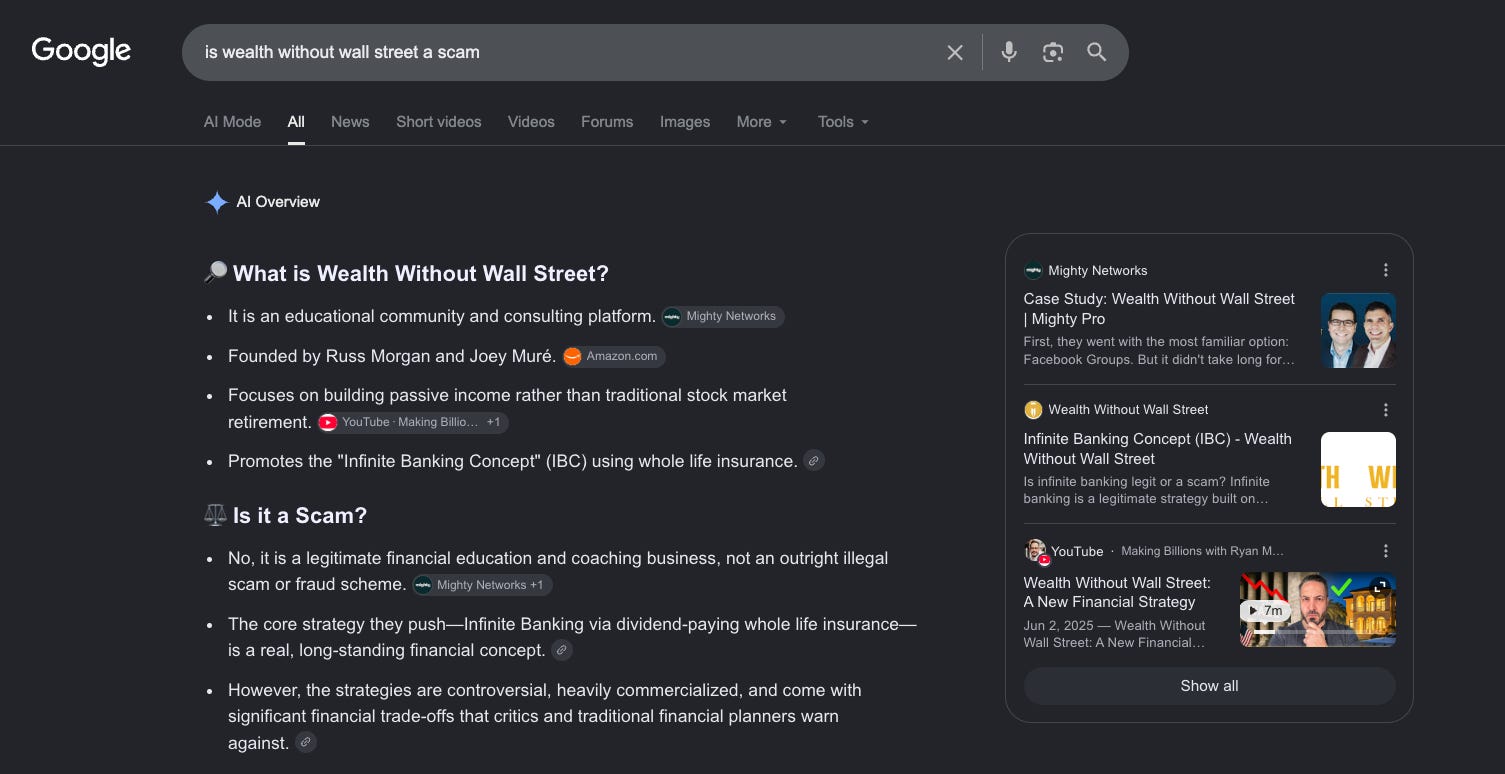
Somewhere along the way you typed “Is Wealth Without Wall Street a scam?” into Google. Maybe that’s how you found this page.
Good. I mean that.
I do the same thing. Before I hand anybody a dollar, I search their name with the word “scam” after it. Contractors, coaches, the guy selling steaks out of the back of a truck. If you’re careful with your money, you check.
So let me save you some digging and tell you what you found, what it means, and what I’d want you to know if you were my brother, my best friend, or my kid.
When you searched us, Google’s own AI said we’re a legitimate financial education company, but “controversial.”
I’ll take that. And I’ll show you why, using four simple principles. These are the same four I’d walk you through if you were sitting across the table from me.
Principle #1: Unfamiliar isn’t the same as unsafe
Here’s something I learned from years on the other side of the desk as an investment advisor.
Most professionals recommend what they were trained on. That’s not a knock on them. It’s human. Your CPA knows the tax code. Your financial planner knows the 401(k), the IRA, the index fund. That’s their world, and they’re good in it.
But ask most of them about what we teach, and you’ll get a raised eyebrow.
Maybe even a lecture.
Not because they studied it and found it broken. Because it’s outside their playbook. And nobody ever got fired for recommending the 401(k).
So when you hear “controversial,” translate it in your head. It usually means “different from what most people were taught.” That’s worth investigating, not running from.
The question isn’t “Has my advisor heard of this?” The question is “Does it work, and does it work for me?”
Principle #2: Money you can’t touch isn’t really working for you
Think about the way most of us were told to build wealth.
Put money in. Don’t touch it for 30 years. Pay tax on the way out. Hope.
That’s not a plan, friend. That’s a waiting room.
And here’s the quiet problem with it. That plan assumes you already know exactly what you’ll want at 45, 55, and 65. But you’re not the same person you were five years ago, are you? Your kids want different things from you at 8 than they will at 15. Opportunities show up that you couldn’t have predicted.
When a great deal lands on your desk, a rental, a business, a piece of land, where’s your money? Locked in an account with penalties for touching it. Or sitting in a savings account earning next to nothing.
You’ve got the money. You just can’t use it.
My favorite way to explain this is a piggy bank. Stick with me for a second, because infinite banking is simpler than anything your advisor ever drew on a whiteboard.
Picture a 10-year-old kid. Let’s call him Jake.
Jake has been saving birthday money and allowance for two years.
He’s got $100 in his piggy bank, and he’s proud of it.
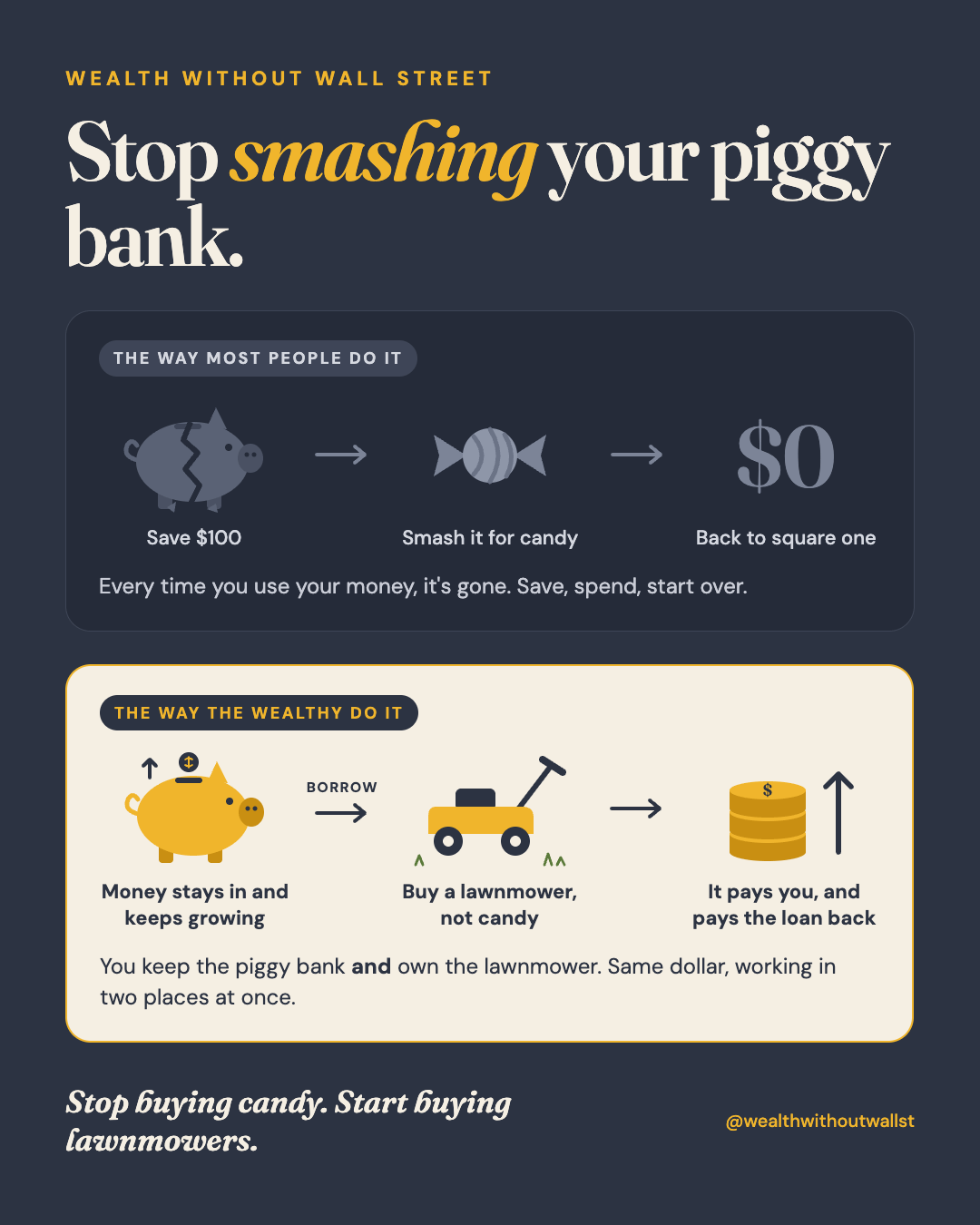
One Saturday, Jake walks past the corner store and sees the candy aisle. He cracks open the piggy bank, grabs the $100, and buys candy.
What happens to the money?
It’s gone. The candy’s eaten by Tuesday, the piggy bank is empty, and Jake is back to square one. Two years of saving, wiped out in a weekend.
That’s how most people use money.
They save for years, then drain the account to buy something. A car. A vacation. Even an investment. Every time they want to use their money, they have to empty the piggy bank to do it. Then they start over.
Now let’s run it back with a different kind of piggy bank.
This piggy bank has a rule. Every year, whatever’s inside grows a little on its own. Jake’s $100 becomes $105 without him doing anything.
And it has one more feature. When Jake wants money, he doesn’t smash the piggy bank. He goes to Grandpa, who says, “Jake, I can see you’ve got $100 in there. I’ll lend you $100 against it. Leave your money right where it is. Just pay me back.”
So Jake’s $100 stays in the piggy bank, still growing.
And he has $100 in his hand to spend.
Here’s where it gets good.
Jake could take Grandpa’s $100 and buy candy. He’d still be better off than before, because his piggy bank is untouched. But candy doesn’t pay him back. He’d have to pay Grandpa out of his allowance.
Jake’s smarter than that. He buys a used lawnmower instead.
Now he knocks on doors and starts mowing lawns for $20 a yard.
Five yards a week is $100 coming in every week.
After a few weeks, Jake has paid Grandpa back, plus a little interest for the favor.
Stop and look at what Jake has now.
His piggy bank still has his money in it, and it kept growing the whole time. He owns all the lawnmowers.
Same $100. Working in two places at once.
But Jake’s not done. He’s busy with baseball, so he pays his cousin $10 a yard to do the mowing. Jake keeps $10 a yard without pushing the mower himself. Now the lawnmower pays him while he’s at practice.
Then he does it again. Borrows against the piggy bank. Buys a second mower. Hires another cousin.
Jake is 10 years old and he’s built a little machine. His savings keep growing, his assets keep producing, and his time is free.
That’s the whole idea we’re about to get into.
Here’s how the pieces map to your world: The piggy bank is a properly designed, dividend-paying whole life policy. Your money sits inside, growing every year, whether you use it or not.
Grandpa is the insurance company. You borrow against your policy’s cash value instead of pulling money out. The money inside keeps compounding as if you never touched it.
The candy is anything that doesn’t pay you back: the car, the boat, the kitchen remodel. Nothing wrong with enjoying life, but candy empties you out.
The lawnmower is an asset that produces income: a rental property, a business, a note, a piece of land.
The cousin is whoever runs the asset for you: a property manager, an operator, a team. That’s what turns active income into passive income.
And paying Grandpa back is you repaying the policy loan, ideally out of what the asset earns. Your piggy bank’s borrowing power gets restored, ready for the next lawnmower.
One honest note, because I promised you straight talk. Grandpa charges interest, and so does the insurance company. This isn’t free money, and it only works if you buy lawnmowers, not candy. That’s why we spend so much time educating our clients on how to choose the right assets based on their buy box and investor DNA inside of the Passive Income Lab, not just set up the policy.
Most people spend their whole lives smashing piggy banks. Save, spend, start over. Save, spend, start over.
The wealthy families, and the banks, figured out a long time ago that you never smash the piggy bank. You borrow against it, buy lawnmowers, and let both keep working.
Principle #3: Store your money where the wealthy store theirs
Old-money families figured this out a long time ago.
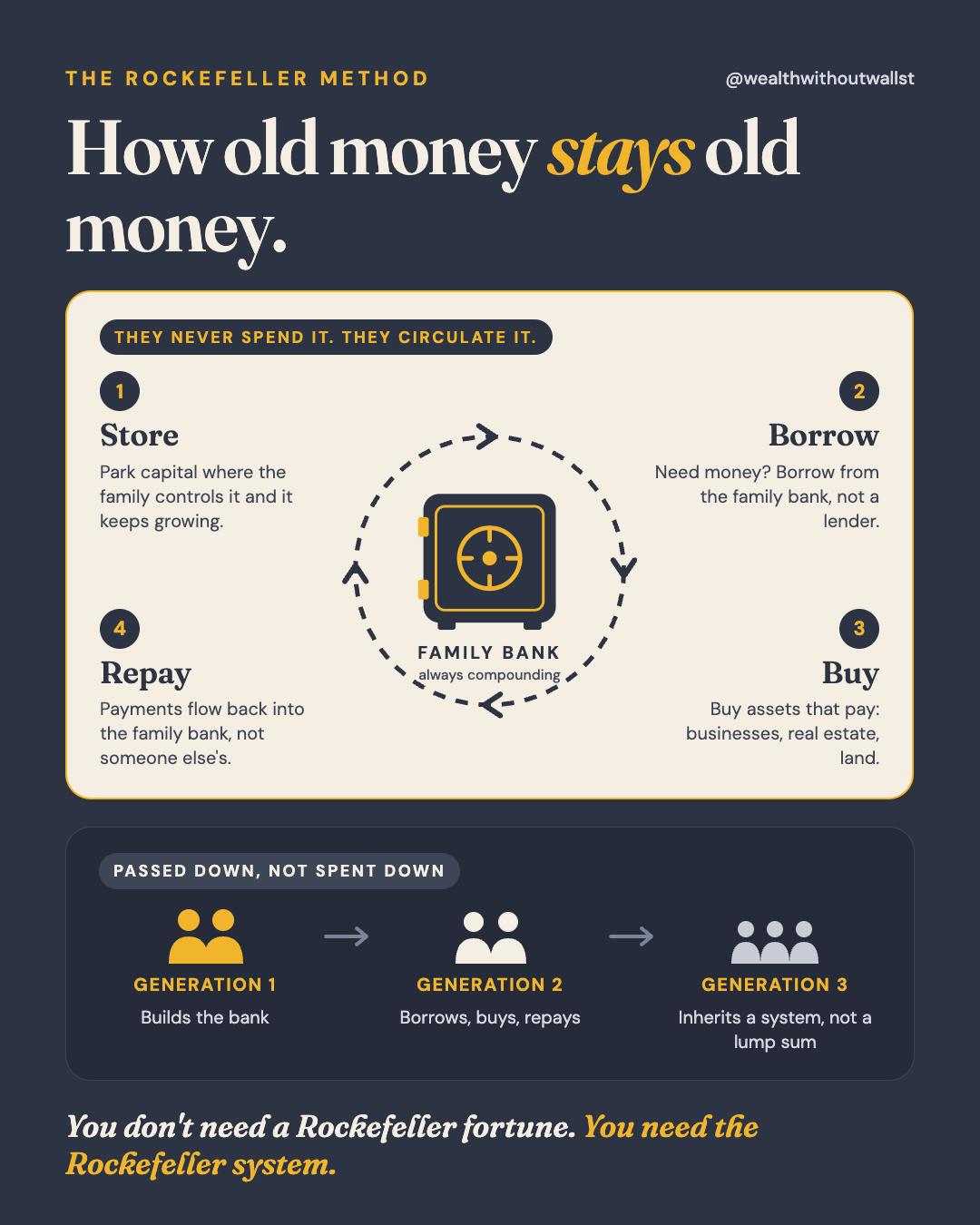
People call it the Rockefeller Method, and the idea is beautifully simple: keep the family’s capital in a place the family controls, borrow against it to buy assets, and never interrupt the compounding. The money doesn’t leave. It gets used.
And here’s the part that’ll make you a little mad.
The banks do the same thing.
Many of the biggest banks in America hold billions of dollars in cash-value life insurance on their own balance sheets. It’s called BOLI, bank-owned life insurance. That’s where they park their own safe money.
Then they take your deposit and lend it back to you at interest.
They earn on both sides. You earn on neither.
So here’s what we teach.
When you set up a properly designed, dividend-paying whole life policy with a mutual insurance company, you become a part owner of that company. In a mutual company, the policyholders are the owners, and they’re the ones who receive the dividends. Those companies have been paying dividends since before the Civil War.
You’re not buying a product off a shelf. You’re putting your money where the institutions put theirs.
Principle #4: Never interrupt compounding
This is where it all clicks. But first I need to be straight with you about who this is for.
This isn’t for someone living paycheck to paycheck. If there’s no cash left at the end of the month, this system has nothing to work with. Fix the cash flow first, then come back.
This is for the doctor, the attorney, the business owner, the executive. You make great money. You write the IRS a painful check every year. And you’ve probably got cash sitting in a savings account, company account or a brokerage account, doing a whole lot of nothing for you.
If that’s you, keep reading.
This part was written for you.
Compounding is a snowball
Picture a snowball at the top of a long hill.
Give it a push and it starts small. But every time it rolls over, it picks up more snow. The bigger it gets, the more snow it grabs on each turn. Near the bottom of the hill, it’s picking up more snow in one roll than it did in the whole first half.
That’s compounding. Growth on top of growth.
Now here’s what nobody tells you.
The snowball doesn’t get big because of the push.
It gets big because nobody stops it.
And most people stop their snowball over and over again.
How most people interrupt their snowball: Say you’ve built up $200,000 in a brokerage account, and a great rental property comes along.
Most people do what they were taught.
They sell $100,000 of investments to buy the property.
Three things just happened, and none of them are good.
First, they probably triggered a taxable event. Sell something that went up, and the IRS takes its cut before you ever see the money.
Second, their snowball got cut in half. That $100,000 isn’t compounding anymore. And it doesn’t just lose this year’s growth. It loses every year of growth that $100,000 would have made for the rest of their life.
Third, they’re starting over. Now they have to rebuild the snowball from a smaller size, back near the top of the hill.
Do that every time you buy an asset, and you’ll spend your whole life pushing snowballs back up the hill.
How the wealthy families and the banks do it
The oldest money in America plays by a different rule: you rarely sell what’s growing. You borrow against it.
The banks do the same thing. They park their own money in cash-value life insurance, let it grow, and lend other people’s money out. The snowball never stops, and they earn on both sides.
Here’s how you do the same thing.
Your cash grows inside a properly designed, dividend-paying whole life policy, tax-deferred. That’s your snowball.
When you want to buy an asset, you don’t cash out. You borrow against the policy. The insurance company lends you the money and uses your cash value as collateral.
Three things happen:
Your snowball keeps rolling. Your full cash value keeps growing as if you never touched it. It doesn’t matter that you borrowed against it.
The IRS doesn’t get invited. A policy loan isn’t income. When the policy is set up and managed properly, borrowing against it isn’t a taxable event.
You never sell anything to use your own money. No liquidating stocks and no draining accounts. You don’t hand over a cut just to access what’s already yours.
Now the rental you bought starts paying you every month. You use that income to pay back the policy loan. When the loan is paid off, you can borrow against your policy again for the next asset.
Same dollar, working in two places at once: growing in the policy and earning in the asset.
That’s the lawnmower and the piggy bank.
One honest note, because I promised you straight talk: policy loans charge interest. This works when you borrow to buy things that pay you, not things that cost you. Lawnmowers, not candy.
Where this came from, and what we added
This is the Infinite Banking Concept that Nelson Nash taught. Joey and I were lucky enough to be mentored by Nelson personally.
What we added is the piece most people skip: using the system to buy assets that pay you every month. Being your own bank is the starting line, not the finish line.
For what it’s worth, Joey and I went from about $2,600 a month in passive income in 2020 to over $50,000 a month today. This system sits under all of it.
The choice in front of you
You can keep doing what everyone else does. Max out the 401(k), sell investments when you need money, and write the IRS a bigger check every year.
That’s a fine plan. Millions of people follow it.
Just don’t expect wealthy-family results from an everybody-else plan.
The families who stay wealthy for generations don’t have secret investments. They have a different system: they store their money where it keeps growing, they borrow instead of selling, and they never stop the snowball.
The question is whether you want to keep pushing snowballs back up the hill, or let yours roll.
Do I need to do infinite banking to join the Passive Income Lab?
No. Not at all.
The Passive Income Lab isn’t an insurance program. It’s where you learn to become a better investor. That means knowing what kind of investor you are, what deals fit you, and how to turn down the 99 that don’t to find the one that does.
As Robert Kiyosaki puts it, there are no good or bad investments, only good or bad investors. Our job is to make you a good one, whatever vehicle you use.
So why do Joey and I talk about infinite banking so much?
Because it’s what worked for us. They say success leaves clues. We studied how the wealthiest families and the banks move their money, and we followed those clues. That system took us from about $2,600 a month in passive income in 2020 to over $50,000 a month today.
We’ll always show you how we do it. Whether you do it too is up to you.
Come to the Lab to become a better investor. Take the banking strategy if it fits, and leave it if it doesn’t. Either way, you’ll leave knowing exactly what to look for in your next deal.
One more thing Google got right
That AI summary also said we get paid when clients set up these policies.
Yep. We do. And I’d rather you hear it from me than find it on page two of Google.
Our sessions are free because if a policy genuinely makes sense for you, the insurance company pays us. If it doesn’t make sense, we’ll tell you straight. You’ll keep doing what you’re doing and sleep better knowing it.
That’s not a scam. That’s how every insurance agent in the country gets paid.
Most of them just won’t say it out loud. We don’t hide anything.
What I’d do if I were you
Keep Googling.
Keep asking hard questions.
That’s what smart people do.
But don’t let “I’ve never heard of it” be the reason you never find out.
If you want to see how this looks with your own numbers, book a free session with our team. We’ll look at where your money sits today, how much you’re paying banks and lenders every month, and how much tax you trigger every time you move money. Then we’ll show you honestly whether this puts you ahead or not.
You can book here: https://apply.wealthwithoutwallstreet.com/
Talk soon, friend.
Russ Morgan
Wealth Without Wall Street
Follow on Linkedin
P.S. Here’s a fun test. Ask your CPA: “If I sell an asset to buy the next one, how much tax do I pay?” Then ask us how to buy the next one without selling anything. Compare the answers. If you don’t like the answers your CPA gives you, book a free session here: https://apply.wealthwithoutwallstreet.com/
P.P.S… If you want to go deeper my partner Joey recorded a 12 minute breakdown of how this concept works on a whiteboard. Watch it here 👇
DISCLOSURE: Wealth Without Wall Street provides educational and informational content only and does not provide legal, tax, financial, or investment advice. Any examples or case studies are illustrative and not a promise or guarantee of results. Earnings or income statements (if any) are not typical, and your results will vary based on factors such as your effort, experience, market conditions, and business decisions. You are responsible for your own actions and outcomes.
Definitely not a scam. Like everyone else, wish I started sooner.